
PIPELINE:
Two Assets on the Same Biochip Platform
By enabling earlier and more precise detection
Fast, highly-sensitive biochip enables early detection and ongoing monitoring
Biomarker Portfolio Under Development
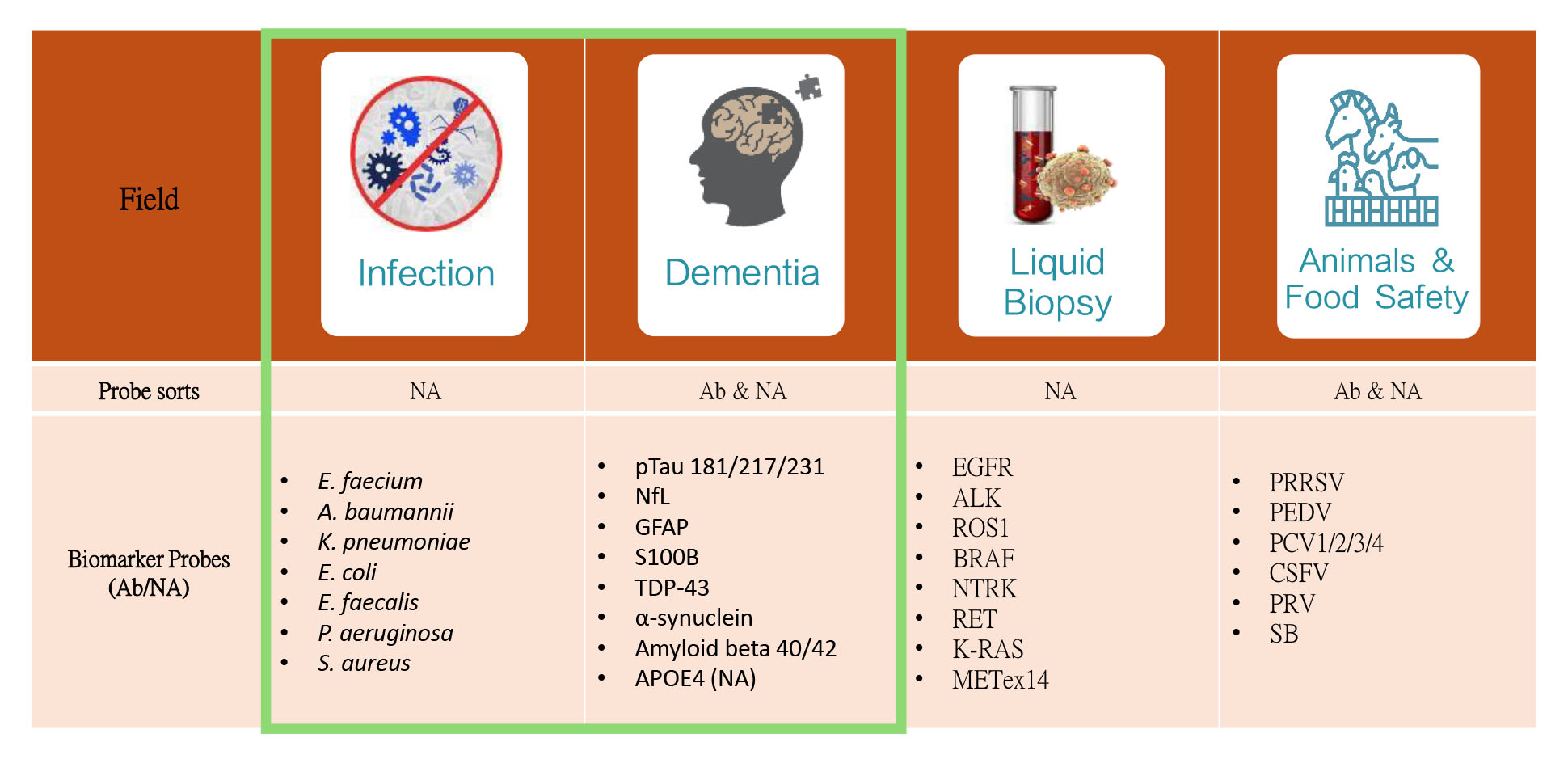
We are currently developing bioassets to address some of the most pressing medical challenges: infectious diseases and dementia. Early and precise detection can drastically improve patient outcomes, reduce healthcare costs, and guide effective treatment strategies.
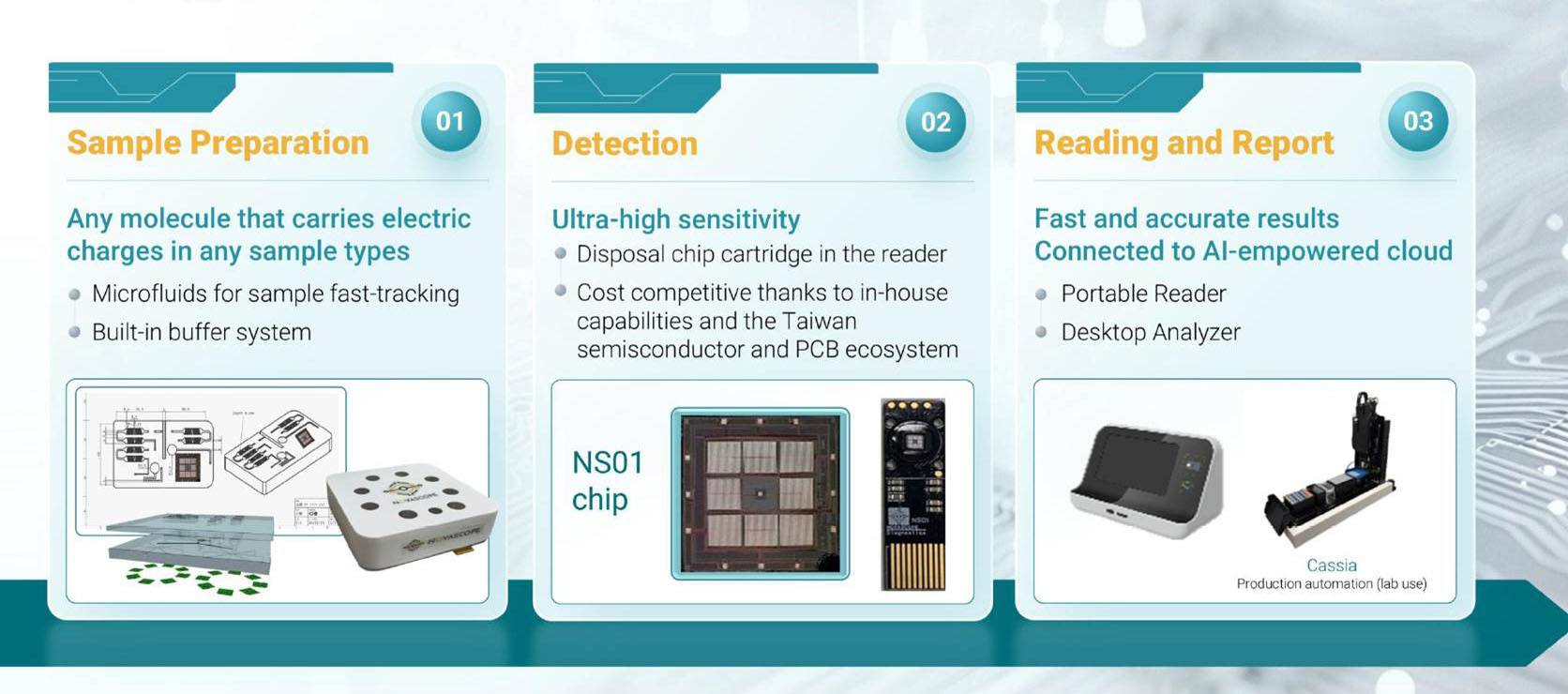
With semiconductors to provide sensitivity and bioassets to ensure specificity, our proprietary biochip platform is uniquely positioned to meet these challenges. It is highly sensitive, capable of detecting low-abundance biomarkers that traditional methods may miss. Thanks to the miniaturization of integrated circuits and our competitive cost structure, our biochip technology platform can deliver diagnostic results on compact-form devices.
What sets our platform apart is its molecule-agnostic design. Whether the target biomarkers are proteins, antibodies, or other molecular signatures, our technology can adapt without the need for extensive reengineering. This flexibility allows us to rapidly expand into multiple indications, respond to emerging infectious threats, and continuously evolve alongside advancements in biomarker discovery.
By combining high sensitivity with molecular versatility, our biochips are not just diagnostic tools—they are a strategic foundation for next-generation precision medicine. We are committed to translating this technological advantage into real-world solutions that improve patient care and empower clinicians with actionable insights.
Alzheimer’s Disease
Novascope’s Biochip Identifies Treatable Patients

The Burden of Alzheimer’s Disease
Alzheimer’s disease is a progressive, irreversible brain disorder that destroys memory, thinking skills, and eventually, the ability to perform day-to-day tasks. As it accounts for approximately 60–80% of dementia cases, Alzheimer’s disease imposes a substantial clinical, economic, and societal burden.
Not curable but treatable if detected early
Although Alzheimer’s disease is not curable, medications and therapies are available to patients in Stage 2 or mild cognitive impairment/early stage to manage symptoms, improve quality of life, and potentially slow cognitive decline.
Neurodegeneration Market — by the Numbers
55 M
Global dementia patients (WHO 2024)
10 M new cases per year
AD THERAPEUTIC LANDSCAPE
Anti-amyloid Rx requires monitoring
Leqembi (lecanemab, 2023) and Kisunla (donanemab, 2024) are FDA-approved disease-modifying antibodies. Both require confirmed amyloid pathology before treatment. PET costs $5–8K and lumbar puncture is invasive — blood biomarker becomes required clinical infrastructure.
$1.3 T
Global cost of dementia, 2024
Projected to reach $2.8 T by 2030
ALS LANDSCAPE
Tofersen — NfL as primary endpoint
Qalsody (tofersen, 2023) approved for SOD1 ALS with NfL as accelerated approval surrogate endpoint. First time FDA accepted NfL as primary clinical evidence — precedent for further accelerated approvals across CNS indications.
$3.95 B
Neuroscience antibodies & assays market 2025
13.5% forecast CAGR 2024–2028
PHARMA R&D PIPELINE
450+ neurological drug candidates
Pharma needs scalable, reproducible biomarker assays for trial enrichment and treatment monitoring. NfL is the closest thing to a universal CNS injury readout — the “cholesterol of the brain”.
Alzheimer’s Disease
NfL Regulatory Path — De Novo First-in-Category Targeted
Initial Focus on Neurofilament Light Chain (NfL)
We are developing what we believe could become the first U.S. FDA De Novo standalone Neurofilament Light Chain (NfL) in vitro diagnostic (IVD) designed to provide semi-quantitative assessment of neuroaxonal injury severity through a proprietary semiconductor-based electronic readout platform.
NfL is one of the most extensively validated blood biomarkers of neuronal damage and neurodegeneration. Elevated plasma NfL levels have been associated with a broad range of neurological conditions, including Alzheimer’s disease, multiple sclerosis, traumatic brain injury, and other neurodegenerative disorders. As disease-modifying therapies move into routine clinical practice, the need for accessible, scalable, and cost-effective biomarker monitoring continues to grow.
While the clinical utility of plasma NfL is increasingly recognized, commercialization has remained technically challenging. Clinical decision thresholds for plasma NfL often reside near the lower limit of quantification (LLOQ) of conventional plate-based immunoassays, typically in the range of approximately 5–10 pg/mL. Furthermore, plasma samples present significant analytical challenges, including interference from hemolysis, biomarker stability concerns, and potential hook effects at elevated concentrations.
NOVASCOPE’s NfL Antibodies
Sequenced recombinant matched pair
- NfL-1 maps to aa 301–360 — SAME epitope region as Uman UD1/UD2. Direct second-source candidate.
- NfL-6 pairs with NfL-1 for sandwich ELISA — Novascope-developed, distinct epitope (likely aa 121–240).
- Sequenced VH/VL → CDMO-portable. Lot CV << hybridoma. Independent supply chain.
- Validated R² = 0.998 vs Simoa NF-Light, slope 1.02 (Quanterix One Sense Service Lab, Aug 8, 2025, Lot #504147).
- Defensibility: 15–20 years if CDR-engineered.
Sepsis
Novascope’s Biochip Helps the Patient’s Race Against Time
The Burden of Sepsis
Despite advances in modern medicine, sepsis remains a critical and growing healthcare challenge because of a narrow clinical window, nonspecific and easily missed early symptoms, slow and indirect diagnostics currently available, and resistance to treatment due to misuse of antibiotics.
According to the Association of American Medical Colleges (AAMC), sepsis is the third leading cause of death in U.S. hospitals. Approximately 1.7 million people develop sepsis and at least 350,000 people die from sepsis in the United States each year. As the early symptoms are nonspecific and infection may be well underway before symptoms, the number of blood culture tests ordered for detection of this disease is approximately 30 million times in the United States each year.
Moreover, sepsis is highly expensive to treat within an “episode of care” due to its status as a critical, multi-organ emergency requiring intensive, prolonged, and specialized medical intervention. Costs are driven by high ICU admission rates, long hospital stays, mechanical ventilation, and costly laboratory diagnostics. In the United States, sepsis is one of the most expensive conditions treated in hospitals, accounting for over $20 billion in annual healthcare costs*. Similar high costs have been reported in Europe, with sepsis-related expenses ranging from €7500 to €27,000 per patient*.
Source: La Via L, Sangiorgio G, Stefani S, Marino A, Nunnari G, Cocuzza S, La Mantia I, Cacopardo B, Stracquadanio S, Spampinato S, Lavalle S, Maniaci A. The Global Burden of Sepsis and Septic Shock. Epidemiologia (Basel). 2024 Jul 25;5(3):456-478.
Prototype Products Ready for Clinical Validations
Sepsis
Reimagining Sepsis Diagnostics Through Multi-Omic Intelligence
Because our biochip can detect both nucleic acids and proteins, we are developing a multi-omic sepsis diagnostic platform designed to deliver three clinically actionable readouts from a single tube of blood in less than four hours. If successful, we will be able to contribute to informed decisions on the second dose of antibotics — the clinical workflow window that drives stewardship and outcomes.
Refined Multi-omic TPP — Three Readouts, One Biochip
READOUT 1 · PATHOGEN ID
7 → 35
Target pool expandable from 7 to 35
Initial 7-pathogen panel at launch (2028 target). Expandable to 35 pathogens on the same chip architecture by updating surface chemistry. Coverage spans the 12 ESKAPE pathogens plus the highest-incidence sepsis organisms (E. coli, S. aureus, Klebsiella, Enterococcus, Candida).
10
AMR resistance gene markers
Built into the same chip from launch. 10 AMR markers including vanA/B, mecA, blaKPC, blaNDM, blaOXA, blaCTX-M, ermB, gyrA — covering the most clinically actionable resistance mechanisms in bloodstream and urinary infections.
3 proteins
Host-response signature
PCT, CRP, IL-6 — Sepsis-3 aligned thresholds. Captures host response to differentiate bacterial sepsis from non-bacterial inflammation. Same chip, protein-format surface chemistry. The differentiator versus pathogen-only platforms.
Request Investor Deck : ir@novascopedx.com

Novascope is a semiconductor-driven biotech company developing ultra-sensitive biochips for rapid, early disease detection and precision diagnostics